Wenzhou AIOU Optical Communication Co., Ltd.



Leave Your Message
-
 Get Your Quote
-
 Email
Mission-critical optical modules and multi-gigabit interface boards tested for zero packet loss, exceptional signal integrity, and continuous enterprise reliability.
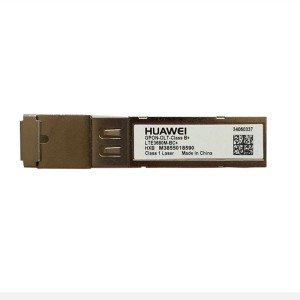
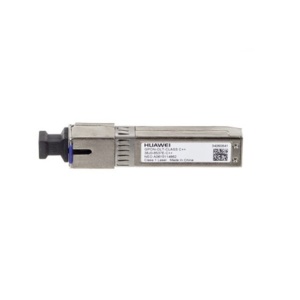
Even as hyperscale facilities migrate toward 400G and 800G fabrics, the 10GBASE-LR 1310nm 10km optical interface remains an irreplaceable workhorse across enterprise, edge, and metropolitan aggregation networks.
Unlike multimode 850nm VCSELs limited to 300 meters, 10G 10km optical transceivers leverage single-mode uncooled 1310nm Distributed Feedback (DFB) laser emitters paired with PIN photodetectors, delivering ultra-low chromatic dispersion and stable transmission across Standard Single-Mode Fiber (SSMF, ITU-T G.652).
Modern data centers employ flat two-tier Clos spine-leaf topologies. The 10G 10km optical interface bridges high-density Top-of-Rack (ToR) switches to distributed aggregation leaves across sprawling campus campuses, offering full line-rate throughput without the packet retransmission penalties of copper DAC cabling.
With an operational power consumption footprint typically under 1.0W per port, modern 10G SFP+ optical modules drastically minimize the thermal envelope of 48-port and 96-port aggregation switches. Reduced heat generation translates to higher Mean Time Between Failures (MTBF) and lowered Data Center PUE ratings.
The contemporary telecommunication and enterprise IT landscape is witnessing massive decentralized data processing. As artificial intelligence inference models and low-latency financial systems shift workloads toward edge facilities, the demand for deterministic, cost-effective intermediate-reach transceivers has intensified. The 10G 10km SFP+ standard (10GBASE-LR) is the de facto benchmark for campus spine connections, metropolitan disaster recovery links, and point-to-point base station aggregations.
Compared to legacy Direct Attach Copper (DAC) cables, which suffer from severe attenuation beyond 5 meters, or Active Optical Cables (AOC) with fixed breakout distances, pluggable 10G 10km transceivers provide unconstrained architectural flexibility. Network designers can route standard LC duplex patch cables through structured patch panels, optical distribution frames (ODF), and optical cross-connects without requiring mid-span signal amplification or re-clocking hardware.
Deploying optical switches across campus networks requires meticulous link budget calculation. A standard 10G 10km transceiver provides a typical minimum optical transmitter power of -8.2 dBm and a receiver sensitivity of -14.4 dBm, offering an optical power margin budget of approximately 6.2 dB. Over standard ITU-T G.652 single-mode fiber with a nominal attenuation coefficient of 0.35 dB/km at 1310nm, the fiber medium consumes approximately 3.5 dB over a 10km span.
This leaves a conservative 2.7 dB safety margin for connector insertion losses (typically 0.25 to 0.5 dB per LC mated pair), fusion splices (0.05 dB per splice), and chromatic dispersion penalties. This predictable margin allows system integrators to achieve bit error rates (BER) below 10^-12, meeting the stringent uptime mandates of Tier-3 and Tier-4 data center facilities without requiring Forward Error Correction (FEC) overhead.
Detailed performance benchmarks comparing standard data center switching optical interfaces across transmission reach, power budgets, and media characteristics.
| Transceiver Standard | Wavelength (nm) | Laser / Detector | Fiber Type | Max Reach | Power Consumption | Core Data Center Application |
|---|---|---|---|---|---|---|
| 10GBASE-LR SFP+ | 1310 nm | DFB / PIN | SMF (G.652) | 10 km | < 1.0 W | Campus Backbones, Leaf-Spine Uplinks, Edge Interconnects |
| 10GBASE-SR SFP+ | 850 nm | VCSEL / PIN | MMF (OM3 / OM4) | 300 m / 400 m | < 0.8 W | Intra-rack, Server-to-ToR switch uplinks |
| 10GBASE-ER SFP+ | 1550 nm | EML / PIN | SMF (G.652) | 40 km | < 1.5 W | Metro Core DCI, Long-haul regional distribution |
| 10GBASE-ZR SFP+ | 1550 nm | Cooled EML / APD | SMF (G.652) | 80 km | < 2.2 W | Regional telecom backhaul, Long-distance transport |
| 25GBASE-LR SFP28 | 1310 nm | DFB / PIN | SMF (G.652) | 10 km | < 1.5 W | Next-Gen Cloud Spine-Leaf, 5G Fronthaul Aggregation |
| 40GBASE-LR4 QSFP+ | 1271-1331 nm (CWDM) | 4x DFB / PIN | SMF (G.652) | 10 km | < 3.5 W | High-bandwidth DC core switching, Carrier trunking |
Examining how high-speed optical transceivers integrate with advanced line cards and service boards in enterprise campus backbones and service provider FTTH nodes.
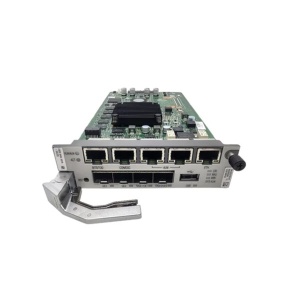
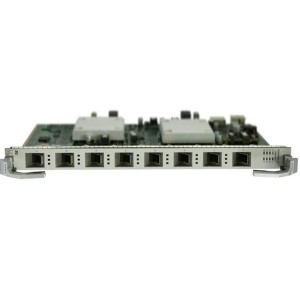
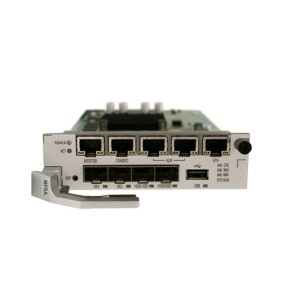
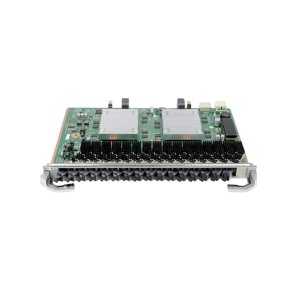
In carrier central offices (CO) and Fiber-to-the-Home (FTTH) access networks, Optical Line Terminals (OLTs) rely heavily on 10GE uplink service boards such as MPSG, FLHF, MPSA, and NXED to channel aggregate subscriber traffic toward core routers. When high-bandwidth symmetric GPON, XG-PON, or 10G-EPON access networks converge hundreds of residential and commercial subscribers onto a single chassis, 10G 10km optical transceivers provide the vital high-speed conduit connecting the OLT chassis to metropolitan aggregation Ethernet switches.
Because FTTH central offices frequently operate in thermally demanding environments with dense rack occupancy, low-power dissipation transceivers prevent thermal hotspots on line cards. Furthermore, the 10km transmission perimeter easily encompasses distributed suburban central offices, eliminating the capital cost of deploying costly DWDM transponders or intermediate regeneration repeaters.
Enterprises implementing synchronous data replication between active-active data center pods demand absolute latency consistency. In metropolitan areas where primary and redundant data center sites are spaced within a 10km radius, 10GBASE-LR transceivers facilitate direct dark fiber connectivity without introducing optical amplification (EDFA) or dispersion compensation modules (DCM).
The predictable optical time-of-flight through standard single-mode silica fiber (approximately 5 microseconds per kilometer) allows SAN storage replication protocols (such as Fibre Channel over Ethernet or iSCSI) to maintain sub-millisecond transaction commit latencies. Digital diagnostic telemetry continuously tracks optical return loss and receive power, allowing automated software-defined networking (SDN) controllers to route traffic proactively before fiber degradation triggers packet drops.
Established in 2006, Wenzhou AIOU Optical Communication Co., Ltd. is a professional high-tech enterprise dedicated to the full industrial chain of optical network access solutions, covering research and development, manufacturing, sales, and after-sales service. We focus on delivering cutting-edge passive optical network (PON) products, including EPON, GPON, and XPON series, which are carefully tailored to meet the diverse needs of global customers in different regions and industries. With a firm commitment to independent innovation, we have built a strong R&D team composed of senior engineers with years of industry experience, holding multiple core technology patents and forming a comprehensive industrial chain, thus effectively serving various sectors such as operator networks, government and enterprise information systems, smart parks, and home broadband access.
Our complete product line covers OLT (Optical Line Terminal), ONU (Optical Network Unit), high-performance optical modules, and network switching equipment, supporting access rates ranging from 10/100M to 10G. These solutions are characterized by high performance, stable reliability, low latency, and easy deployment, perfectly aligning with customers’ demands for secure, stable, and high-speed communication networks. All our products have passed strict CE certification, as well as other international quality certifications, and are exported to more than 20 countries and regions across South America, Africa, Eastern Europe, Southeast Asia, and the Middle East, winning wide recognition from global partners for their superior quality and cost-effectiveness.
We operate a standardized 2,000-square-meter production zone equipped with advanced automated production and testing equipment, where we strictly adhere to ISO9001 quality management systems, CCC, and CE standards to ensure the consistency and reliability of each product. Our core mission is to exceed customer expectations by providing premium quality products, efficient and thoughtful after-sales services, and industry-leading technical support, continuously driving technological innovation and development in the global optical network infrastructure field.
Answers to critical engineering queries regarding compatibility, link loss calculations, and switch platform deployments.
Yes. Because 10GBASE-LR transceivers use PIN receivers (unlike high-sensitivity APD receivers found in 80km ZR modules), their optical receiver overload threshold is typically around +0.5 dBm. Since the maximum transmit power is around -0.5 dBm to -1.0 dBm, the receiver will not be damaged or saturated over short patch cords, meaning optical attenuators are generally not required.
10GBASE-SR uses 850nm VCSEL lasers over OM3/OM4 multimode fiber (MMF) for reaches up to 300m/400m, optimal for intra-rack or within-hall connectivity. 10GBASE-LR utilizes 1310nm DFB lasers over standard G.652 single-mode fiber (SMF) for distances up to 10km, providing higher immunity to modal dispersion across campus and metro links.
DOM (compliant with SFF-8472) provides real-time telemetry on five vital operating parameters: internal module temperature, transceiver supply voltage, laser bias current, transmitted optical power (TX), and received optical power (RX). This allows network administrators to isolate fiber cuts, dirty end-faces, or laser degradation prior to link failure.
10G SFP+ modules are physical form-factor backward compatible with SFP cages, but the host switch port must support multi-rate negotiation or manual speed locking. When inserted into 25G SFP28 ports, most enterprise switches allow speed configuration down to 10G, enabling seamless tiered bandwidth upgrades.
Optical loss stems primarily from intrinsic fiber attenuation (0.35 dB/km at 1310nm), mechanical splices, macro-bending losses from tight bend radiuses in fiber trays, and contaminated LC connectors. Regular inspection and wet-dry connector cleaning are critical to maintaining link budgets above margin thresholds.
In a 48-port 1RU 10GbE switch, if each transceiver consumes 1.5W, the module subsystem alone dissipates 72W of heat. Opting for energy-optimized 10GBASE-LR modules consuming below 1.0W reduces switch thermal dissipation by over 30%, lowering rack cooling demands and ensuring prolonged component lifespan.
Explore our complete spectrum of GPON, XG-PON, and 10GE optical modules and high-speed service switching boards engineered to global quality benchmarks.