Picking the best SFP fiber modules from China? It’s not just about who has the lowest price. What really matters is whether they’ll play nicely with your gear, stay stable optically, pass real testing, and come from a supplier who actually supports you after the sale. Two modules can look exactly the same on a product page, but behave very differently once they’re in a switch, a data center rack, or some dusty industrial cabinet.
So this guide looks at Chinese suppliers from a practical buyer’s angle. We’ll talk transceiver types, reach, wavelength, connector style, temp range, and data rates. Also, how manufacturers check units before they ship. A trustworthy supplier should hand over test records, clear specs, and serial numbers you can trace. Names like FS.com, H3C, and TP-Link are familiar, sure, but brand name alone won’t save you. You still need to confirm compatibility with Cisco, Juniper, Huawei, Arista, or whatever kit you’re running.
The small details matter.
A solid supplier should explain coding options, optical budgets, returns, and warranty terms in plain English—not vague marketing talk. Factory testing might include temperature cycling, digital diagnostics, and insertion-loss checks. That’s great, but it doesn’t guarantee perfect performance in the field. Installation quality, dirty fiber, and switch firmware can all throw things off. And honestly, this is where a lot of comparisons get overconfident. A cheap module might be fine on a lab bench, then struggle once it’s hot or pushing heavy traffic. So the best pick really depends on your network design, where it’s going to live, and how much support you expect. Bottom line: use this overview to separate measurable value from shiny marketing claims—but always verify supplier data yourself.
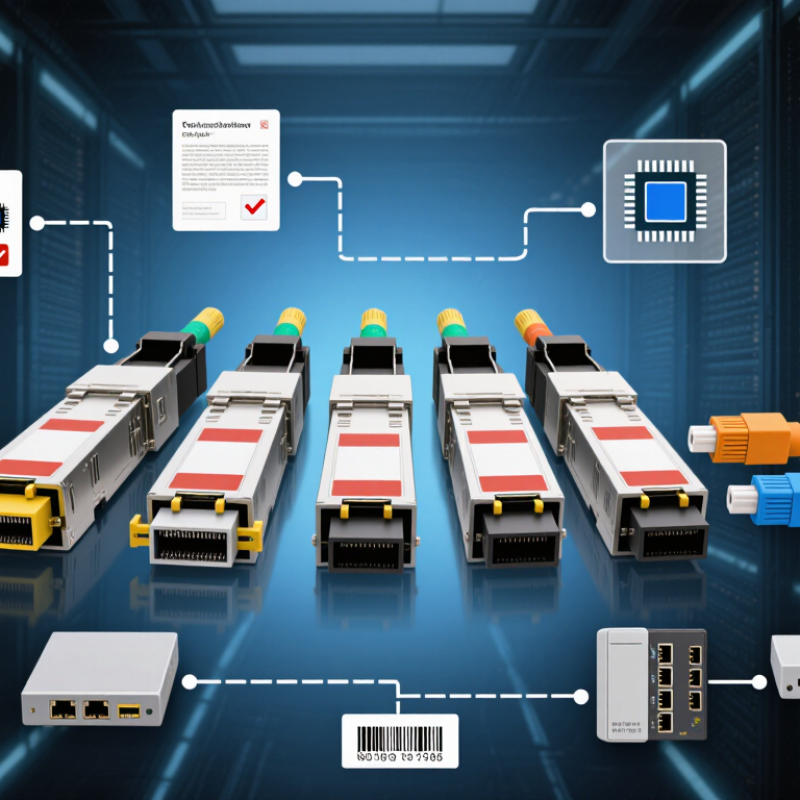
SFP fiber modules are compact, pluggable transceivers that connect network equipment through fiber. They convert electrical signals into optical pulses, then convert received light back into data. Their small form factor supports quick replacement without changing an entire switch. That matters in crowded racks.
For access networks, Sfp Pon Modules serve a more specific role. They operate within Passive Optical Network systems, where one optical line can serve multiple subscribers through passive splitters. Typical modules support defined upstream and downstream wavelengths under standards such as ITU-T G.984 and G.9807.1. An installer should check reach, fiber type, temperature range, transmission speed, and optical power budget. A module that fits physically may still fail operationally.
Demand is closely tied to network growth. Cisco’s Annual Internet Report forecast 29.3 billion connected devices by 2023, increasing pressure on access infrastructure. Dell’Oro Group’s broadband access research also continues to track strong PON equipment investment across global markets. These figures explain why reliable SFP selection matters beyond price. In field testing, digital diagnostics can reveal abnormal temperature, voltage, bias current, or received power before service drops. Yet monitoring is not perfect. Dust, connector loss, and mismatched wavelengths can distort readings. Compatibility testing remains necessary, especially when modules come from different manufacturing batches.
China’s SFP fiber modules cover several practical categories. The common 1G SFP types include 1000BASE-SX for short multimode links and 1000BASE-LX for longer single-mode runs. SX usually fits a data-center aisle. LX can reach about 10 kilometers over suitable fiber. BiDi SFPs use different wavelengths on one strand, saving cabling in crowded cabinets.
Higher-speed options include SFP+, SFP28, and selected 25G or 10G optical variants. SFP+ commonly supports 10Gbps, while SFP28 supports 25Gbps under suitable network equipment. CWDM and DWDM SFP modules carry separate wavelengths, helping operators expand capacity without installing new fiber. LightCounting’s 2024 optical transceiver market data indicates strong growth in 800G demand, with shipments expected to exceed one million units. That trend also increases interest in lower-speed modules for network edges.
In practical purchasing, wavelength, connector type, fiber mode, reach, temperature rating, and digital diagnostics must match. I have seen a module pass a bench test but fail after installation because the switch rejected its coding. That detail is easy to miss. Search terms such as Cisco Sfp Modules may describe compatibility needs, but the exact host platform still requires verification. Omdia’s 2024 optical transceiver research highlights interoperability and power efficiency as important selection factors. A clean datasheet is not enough. Check DOM readings, optical budgets, and return procedures before ordering. Some low-cost modules perform well; others need deeper testing.
Choosing the best Fiber Sfp module from China requires more than comparing prices. Start with the data rate and port type. An SFP module may support 1Gbps, while an SFP+ module can handle 10Gbps. Confirm the switch port before ordering. A mismatch can leave the link inactive.
Wavelength and transmission distance also matter. Single-mode modules commonly use 1310nm or 1550nm for links from several kilometers to longer campus connections. Multimode models often use 850nm and shorter distances. Check the fiber core, connector type, and optical budget together. A module rated for 10 kilometers may perform poorly if the receiver sensitivity is overlooked. Small details matter.
I also compare transmit power, receiver sensitivity, operating temperature, and digital optical monitoring. DOM can reveal rising temperature or weakening optical power during maintenance. That helps technicians find faults before complete failure. In field checks, I test modules with an optical power meter and a loopback plug, not only the switch dashboard. It is slower. It is safer.
Compatibility deserves careful attention. Confirm coding, protocol support, EEPROM information, and hot-plug behavior with the equipment supplier. Some low-cost modules meet basic specifications but show unstable readings under heat. I once treated a temperature rating as a minor detail; that assumption required a replacement. For outdoor cabinets or crowded racks, industrial-temperature versions may justify their higher cost. Test a sample batch first. Specs can look perfect on paper.
What Are the Best SFP Fiber Modules from China?
How Chinese SFP Modules Are Manufactured and Tested
Chinese SFP manufacturing usually begins with approved optical components, circuit boards, and metal housings. Production teams mount the TOSA, ROSA, driver chip, and EEPROM onto compact boards. Automated soldering improves consistency, although small alignment errors can still affect optical power. Technicians then install firmware and record the module’s serial data. LightCounting’s 2024 Optical Communications Market Forecast identifies data-center connectivity as a major driver of optical transceiver demand, especially for higher-speed modules.
Testing is more than checking whether a link turns on. Engineers measure transmit power, receiver sensitivity, extinction ratio, wavelength accuracy, and bit-error rate. They also inspect eye diagrams and verify digital diagnostics. Many factories follow IEEE 802.3 requirements and use Telcordia GR-468 practices for reliability screening. Temperature cycling, humidity exposure, vibration tests, and extended burn-in help reveal early failures. The process is disciplined.
Still, testing can be imperfect. A module may pass a short laboratory test but behave differently inside a crowded switch cabinet. Dell’Oro Group’s 2024 Ethernet Switch research highlights continued growth in high-speed data-center connections, increasing pressure for stable 400G and 800G optics. Reliable suppliers therefore compare results across temperature ranges and production batches. They should provide traceable test records, not only a pass label. In practical evaluations, engineers often retest samples after shipping, because connector contamination and handling damage remain easy to overlook.
Standardized maximum reach of common SFP-family optical links
The best module depends on transmission speed, fiber type, wavelength, and required distance. SX and SR modules are designed for short-range multimode fiber links, while LX and LR modules use 1310 nm optics for longer single-mode fiber connections. During manufacturing, optical power, wavelength, extinction ratio, temperature stability, and bit-error performance are commonly verified against the applicable Ethernet specifications.
Reference basis: IEEE 802.3 optical Ethernet specifications. Distances represent typical maximum link lengths under the stated fiber conditions and are not a guarantee for every installation.
Compatibility determines whether a China-made SFP module works reliably, not its country of origin. Check the switch port speed, wavelength, fiber type, connector, and transmission distance. The SFP Multi-Source Agreement defines mechanical dimensions and electrical interfaces. SFF-8472 also supports digital diagnostics, including temperature, voltage, and optical power readings.
A Dual Fiber Sfp uses separate fibers for sending and receiving signals. It suits campus networks, access links, and short data-center connections. Single-mode modules commonly support longer distances, while multimode versions fit shorter links. IEEE 802.3 standards help confirm Ethernet speed and reach. However, standards do not guarantee identical vendor coding. I have seen a module pass optical tests but remain unrecognized by a switch. That fault is easy to miss.
Cisco’s Annual Internet Report projected global IP traffic at 396 exabytes per month in 2022, increasing pressure on network upgrades. Dell’Oro Group’s Ethernet Switch research also shows continued demand for higher-speed data-center connections. Tips: Match the module’s EEPROM coding with the switch. Test DOM readings before deployment. Keep a spare with the same wavelength. Chinese suppliers can provide strong value, but quality varies between batches. Request test reports, operating-temperature data, and IEC or RoHS documentation. A lower price is not always a lower risk, though I still question any supplier that avoids sample testing.
| Module Type | Ethernet Standard | Data Rate | Optical Wavelength | Fiber Type | Typical Reach | Connector | Recommended Network Applications | Key Compatibility Considerations |
|---|---|---|---|---|---|---|---|---|
| 1000BASE-SX SFP | IEEE 802.3z | 1.25 Gb/s line rate 1 Gb/s Ethernet |
850 nm | Multimode fiber OM1, OM2, OM3, or OM4 |
Up to 275 m on OM1 Up to 550 m on OM2 Up to 1,000 m on OM3/OM4, depending on installation |
Duplex LC | Data-center access links, server aggregation, campus building connections, and short-distance switch uplinks | Both network devices must support 1000BASE-SX. Use multimode fiber and match the transceiver speed, connector type, and optical budget. |
| 1000BASE-LX SFP | IEEE 802.3z | 1.25 Gb/s line rate 1 Gb/s Ethernet |
1310 nm | Single-mode fiber; can operate over multimode fiber with suitable mode-conditioning practice | Up to 10 km on single-mode fiber Typically up to 550 m on multimode fiber with appropriate installation |
Duplex LC | Campus backbones, metropolitan access networks, inter-building links, and enterprise distribution layers | Confirm whether the host port supports 1000BASE-LX. For multimode deployments, verify mode-conditioning requirements and link-loss limits. |
| 1000BASE-T SFP | IEEE 802.3ab | 1 Gb/s Ethernet | Electrical copper interface | Category 5e or better twisted-pair copper | Up to 100 m | RJ45 | Connecting fiber-capable switches to copper-based servers, access points, cameras, and legacy network segments | Although it uses an SFP form factor, it is not a fiber module. Check host-device support for copper SFPs, power consumption, auto-negotiation, and supported cable category. |
| 100BASE-FX SFP | IEEE 802.3u | 100 Mb/s Ethernet | 1310 nm | Multimode fiber | Up to 2 km under standard 100BASE-FX multimode conditions | Duplex LC | Industrial networks, older campus networks, access control systems, and legacy Ethernet equipment | The host port must support 100 Mb/s fiber operation. A 100BASE-FX module should not be assumed to negotiate automatically with a 1000BASE-X port. |
| 10GBASE-SR SFP+ | IEEE 802.3ae | 10.3125 Gb/s line rate 10 Gb/s Ethernet |
850 nm | Multimode fiber OM1, OM2, OM3, or OM4 |
Up to 33 m on OM1 Up to 82 m on OM2 Up to 300 m on OM3 Up to 400 m on OM4 |
Duplex LC | Data-center server access, top-of-rack links, storage networks, and short switch-to-switch connections | Use an SFP+ port or a host port explicitly rated for 10 Gb/s operation. Verify the installed multimode grade, polarity, and total channel loss. |
| 10GBASE-LR SFP+ | IEEE 802.3ae | 10.3125 Gb/s line rate 10 Gb/s Ethernet |
1310 nm | Single-mode fiber | Up to 10 km | Duplex LC | Data-center interconnects, campus backbones, metropolitan networks, and long switch uplinks | Check that both endpoints support 10GBASE-LR and that the single-mode link loss, connector count, and splice budget remain within specification. |
| 10GBASE-ER SFP+ | IEEE 802.3ae | 10.3125 Gb/s line rate 10 Gb/s Ethernet |
1550 nm | Single-mode fiber | Up to 40 km | Duplex LC | Metropolitan-area links, regional campus networks, utility communications, and extended data-center interconnects | Long-reach optics require careful optical-budget verification. Excessive received power on short links may require an attenuator approved for the optical design. |
| 1G BiDi SFP | 1000BASE-BX; IEEE 802.3ah-compatible variants are common | 1 Gb/s Ethernet | Usually 1310/1490 nm or 1310/1550 nm paired optics | Single-mode fiber | Commonly 10 km to 40 km, depending on the optical grade | Simplex LC | Fiber-to-the-building, access networks, point-to-point campus links, and situations where only one fiber strand is available | BiDi optics must be installed as a wavelength-matched pair. The transmit wavelength of one end must match the receive wavelength of the other end. |
| 10G BiDi SFP+ | 10GBASE-BX; vendor interoperability should be verified | 10 Gb/s Ethernet | Common wavelength pairs include 1270/1330 nm or 1330/1270 nm | Single-mode fiber | Commonly 10 km, with longer-reach versions available | Simplex LC | 10 Gb/s access networks, constrained fiber routes, and point-to-point links using one strand of single-mode fiber | Use the correct opposite-end wavelength. Confirm FEC requirements, host-port support, optical budget, and interoperability before deployment. |
| CWDM SFP/SFP+ | Ethernet rate depends on the module; ITU-T G.694.2 wavelength plan is commonly used | Typically 1 Gb/s or 10 Gb/s | Coarse WDM channels commonly spaced at 20 nm across the 1270–1610 nm range | Single-mode fiber | Often 10 km, 40 km, or 80 km, depending on optical power and equipment design | Duplex LC | Metro Ethernet, campus backbone expansion, multi-service transport, and increasing capacity over existing fiber pairs | Each wavelength must match the passive multiplexer/demultiplexer channel. Verify channel spacing, insertion loss, dispersion limits, and supported Ethernet rate. |
| DWDM SFP/SFP+ | Ethernet rate depends on the module; ITU-T G.694.1 grid is commonly used | Typically 1 Gb/s or 10 Gb/s | Fixed dense-WDM channels, commonly based on the 100 GHz or 50 GHz frequency grid | Single-mode fiber | Reach varies widely, commonly 40 km to 80 km or more with suitable amplification and dispersion planning | Duplex LC | High-capacity metropolitan links, regional networks, data-center interconnects, and wavelength-routed transport systems | Confirm exact channel frequency, nominal wavelength, launch power, receiver sensitivity, dispersion tolerance, and compatibility with the optical line system. |
| Industrial-Temperature SFP/SFP+ | Depends on the selected Ethernet standard | Commonly 100 Mb/s, 1 Gb/s, or 10 Gb/s | Depends on optical design | Multimode or single-mode fiber | Depends on the selected optical interface | Usually duplex or simplex LC | Factory automation, substations, transportation systems, outdoor cabinets, and surveillance networks | Choose an operating-temperature range appropriate for the enclosure, often wider than commercial temperature ratings. Check vibration, humidity, power, DOM support, and host validation. |
Selecting a reliable Chinese SFP supplier requires more than comparing unit prices. LightCounting’s 2024 optical transceiver forecast expects the global market to exceed US$20 billion by 2028. That growth attracts capable factories and careless traders. Ask whether the supplier owns production lines, performs optical testing, and controls firmware programming. A polished certificate folder is not proof.
Request samples from the same production batch. Test insertion loss, return loss, transmit power, receiver sensitivity, and DOM readings. Check operation at the stated temperature range. For 10G and 25G modules, verify IEEE 802.3 compliance and accurate interoperability records. The 2024 Omdia optical networking report highlights accelerating demand for higher-speed data-center connectivity, making traceability increasingly important. A supplier should provide serial-number records, component sources, test logs, and a clear failure-analysis process.
Audit response quality, too. Can the engineer explain a fluctuating optical power reading? Can the sales team describe replacement timing without vague promises? I have seen inexpensive samples pass briefly, then fail after thermal cycling. That experience still makes me cautious. Request a small pilot order before signing a large contract. Review warranty terms, lead-time history, packaging protection, and export documentation. Independent laboratory reports help, but they should support factory evidence, not replace it. Reliability is built through repeatable testing, honest limitations, and documented corrective action.
It is a compact, pluggable transceiver for fiber networks. It converts electrical signals into light and back again. Fit is not enough.
They can be replaced without changing the entire switch. This reduces downtime and simplifies maintenance. Keep one spare nearby.
Check port speed, wavelength, fiber type, connector, distance, temperature range, and optical power budget. A physically matching module may still fail operationally.
It uses one fiber for transmission and another for reception. It suits campus links, access networks, and short data-center connections. The setup is easy to misunderstand.
Diagnostics can show temperature, voltage, bias current, and received optical power. These readings may reveal problems before service stops. Readings are not perfect.
Switches may check internal coding stored in the module. Coding differences can prevent recognition, even when optical tests pass. Test the module with the target switch.
Ask for same-batch samples, test logs, serial records, and temperature data. Review production control, firmware programming, warranty terms, and failure handling. A polished certificate folder proves little.
Test insertion loss, return loss, transmit power, receiver sensitivity, and diagnostic readings. Run thermal cycling when possible. Small samples can pass briefly, then fail later.
Components, firmware, and assembly quality can vary between batches. Request samples from the planned production batch. I remain cautious after seeing inexpensive samples fail after heating.
Not necessarily. A lower price may hide weak testing, poor packaging, or unclear replacement support. Compare evidence, not promises.
Sfp Fiber Modules are compact transceiver components that convert electrical signals into optical signals, enabling high-speed data transmission across fiber networks. Chinese manufacturers offer various types, including single-mode and multimode modules, short- and long-distance options, single-fiber and dual-fiber designs, and different transmission rates. When comparing products, network planners should evaluate wavelength, transmission distance, data rate, connector type, operating temperature, power consumption, and diagnostic capabilities.
Reliable Chinese Sfp Fiber Modules are typically produced through controlled assembly, optical alignment, performance calibration, and quality testing. Buyers should also confirm compliance with common industry standards, equipment compatibility, and suitability for applications such as data centers, telecommunications, enterprise networks, and security systems. Selecting a dependable supplier requires reviewing technical documentation, testing procedures, customization support, delivery consistency, warranty terms, and after-sales service. A careful comparison of these factors helps ensure stable performance, efficient deployment, and long-term network reliability.